

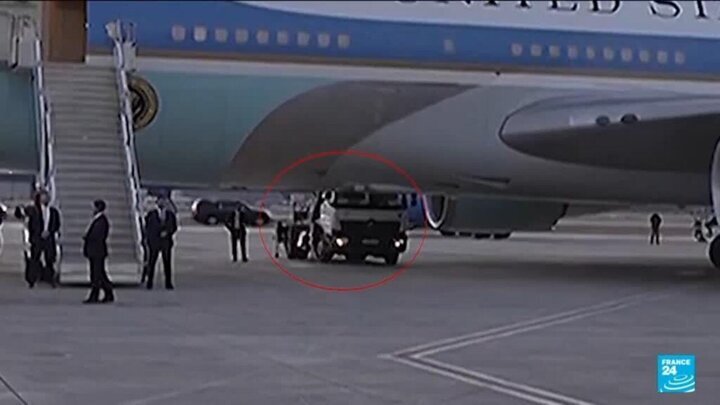
Trump began the war against Iran with a clear calculation: a show of American power should force Tehran to back down while simultaneously portraying himself as a strong and invincible president. But months later, the image that remains of the war is far from what the US president had imagined at the beginning. Perhaps no image better illustrates this shift in the equation than Trump’s secret transfer in a food truck.
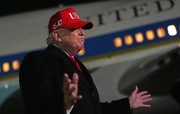
The Washington Post reported that after the NATO summit in Ankara, Trump publicly boarded the presidential plane, and minutes later was secretly transferred to a smaller military plane using an airport food truck. The main plane, which was carrying journalists and a number of US government officials, including Marco Rubio and Scott Besant, effectively played the role of a “decoy plane.” Trump flew to England on another plane and returned to the presidential plane at Mildenhall Air Base.
Reuters also linked the move to a credible threat that a shoulder-launched missile might be used against Trump's plane. Trump acknowledged the incident, but tried to downplay its significance. He said he had only done what the Secret Service asked him to do, and in his usual tone claimed that "influential" presidents receive a lot of threats and that he himself may even be "the most influential president." But the real issue is not Trump's words; it is the decision of the US security apparatus.
If the threat was not serious, why would the US president have to be taken off his official plane at a foreign airport and transferred to another plane by a food truck? Why would his main plane be used as bait? And why would the US security establishment have to design such a sophisticated operation to protect the president?
Of course, a distinction must be made between “US intelligence assessment” and “definitive proof of a threat.” American media reporting on the possibility of an Iranian threat does not in itself prove Tehran’s decision to attack Trump. But even if we set that claim aside, one fact remains: the US security apparatus assessed the potential threat as so serious that it resorted to deception and aircraft modification to relocate the president.
This story becomes even more significant when placed alongside reports of increased security around Trump within the United States. The deployment of air defense systems near his golf course in Bedminster, New Jersey, paints another picture of the same security environment.
The president, who tries to present a fearless and commanding image in his speeches, is now protected by tight security in various settings. This is not a weakness in itself; protecting the president is the natural duty of the security apparatus. But in the context of the Iran-US war, these images take on a different political meaning. Trump started the war to demonstrate power; but the war, along with America’s power, also exposed its vulnerabilities.
Trump believed that by attacking Iran, he could do what American presidents in decades had failed to do: change Tehran’s calculations and impose Washington’s will. For him, the war was not just a military operation; it was an opportunity to build a political brand. He wanted to portray himself as a president who, unlike others, would not back down and could finish the job. But Iran did not play by this scenario.
The 40-day war not only failed to produce the quick and inexpensive results that Washington had hoped for, but also called into question many of America’s calculations about Iran. Iran demonstrated that, even under intense military pressure, it had the capacity to continue resisting, to respond, and to impose costs. This transformed the war from a limited operation to achieve specific objectives into a complex and eroding crisis. The most important issue for America is that it cannot easily predict the outcome of such a war.
In many past wars, Washington has tried to swing the balance in its favor in a short period of time with air superiority and massive firepower. But with Iran, the situation is different. Its geographical size, scattered infrastructure, missile and drone capabilities, decades of experience in dealing with external pressure, and capabilities that the other side does not have complete information about, make it difficult to plan for a new war. Iran is not a country that can be defined by a few military objectives on a map.
Any major conflict with Iran could have far-reaching implications beyond its borders. US military bases in the region, energy routes, the security of the Persian Gulf and the Strait of Hormuz, and even the global economy could be affected. For this reason, any military decision against Iran is not just a decision about the battlefield; it is a decision about a set of regional and global consequences.
On the other hand, the continuation of the war has created heavy costs for America itself. The Washington Post previously reported that the Pentagon has faced pressure on financial resources and weapons stocks as a result of the war with Iran, and even some budgets related to training and maintenance of military equipment have been under pressure.
This is a big deal. The United States is a great military power, but its military resources are not unlimited. A prolonged war with Iran could sap some of the capacity America needs to compete with China, Russia, and other global threats. As a result, the question for Washington today is no longer simply, “How do we defeat Iran?” The more important question is, “How do we get out of this situation?”
This is where the concept of a quagmire comes in. A quagmire does not necessarily mean military defeat. A quagmire forms when a quick victory is not possible, the cost of continuing the war is increasing, and getting out of it is becoming equally difficult.
Trump now faces such an equation. If he continues the war, he will have to pay more and accept the possibility of a wider conflict. If he backs down, he will damage the image he has built of himself as an invincible president. If he negotiates, he will have to convert some of the pressure he has created for Iran to surrender into political concessions. That is why, alongside the public threats, there are also signs of an effort to keep the path to diplomacy open.

This dichotomy is not accidental. Military threats can be used to increase pressure at the negotiating table, but when the other side shows that it is not afraid of threats and can impose costs, threats alone lose their effectiveness. Iran showed in this war that power is not limited to the number of fighter jets, aircraft carriers and military budgets. Power is the ability to resist, the ability to respond and, most importantly, the ability to change the other side’s calculations. In such a situation, the image of Trump in the food truck is more than a security incident; it is a symbolic image.
A president who wanted to enter the war with a show of force now needs deception, a change of plane, and a covert move to get through a foreign airport safely. This does not mean that the US security service has failed; on the contrary, it could be a sign of its professionalism. But from a political perspective, this picture shows that the threat that Washington has taken into account has now become a serious issue even for the president’s personal security.
Perhaps that is the bitter irony of the story: Trump started the war to prove that he is a president who fears no one; but the war that was supposed to demonstrate American power is now producing images of the US president’s vulnerability and security concerns. Trump wanted to force Iran to back down, but today he himself is faced with a difficult equation: continuing the war, more expensive; backing down, political cost; and negotiating, accepting the fact that military pressure has failed to force Tehran to surrender. For this reason, the “getaway truck” can be seen as more than a controversial image. The truck symbolizes a change in a calculation; a calculation that Trump started the war to change, but that Washington itself was ultimately forced to reconsider.
Trump wanted to drag Iran into a quagmire, but now there are signs that he himself is stuck in the same quagmire; a quagmire that will become harder to get out of the more he resorts to force. And perhaps the most important message of this war is this: Against Iran, even the world's greatest military power cannot be sure that it will end the war the way it started.
MNA



Your Comment